
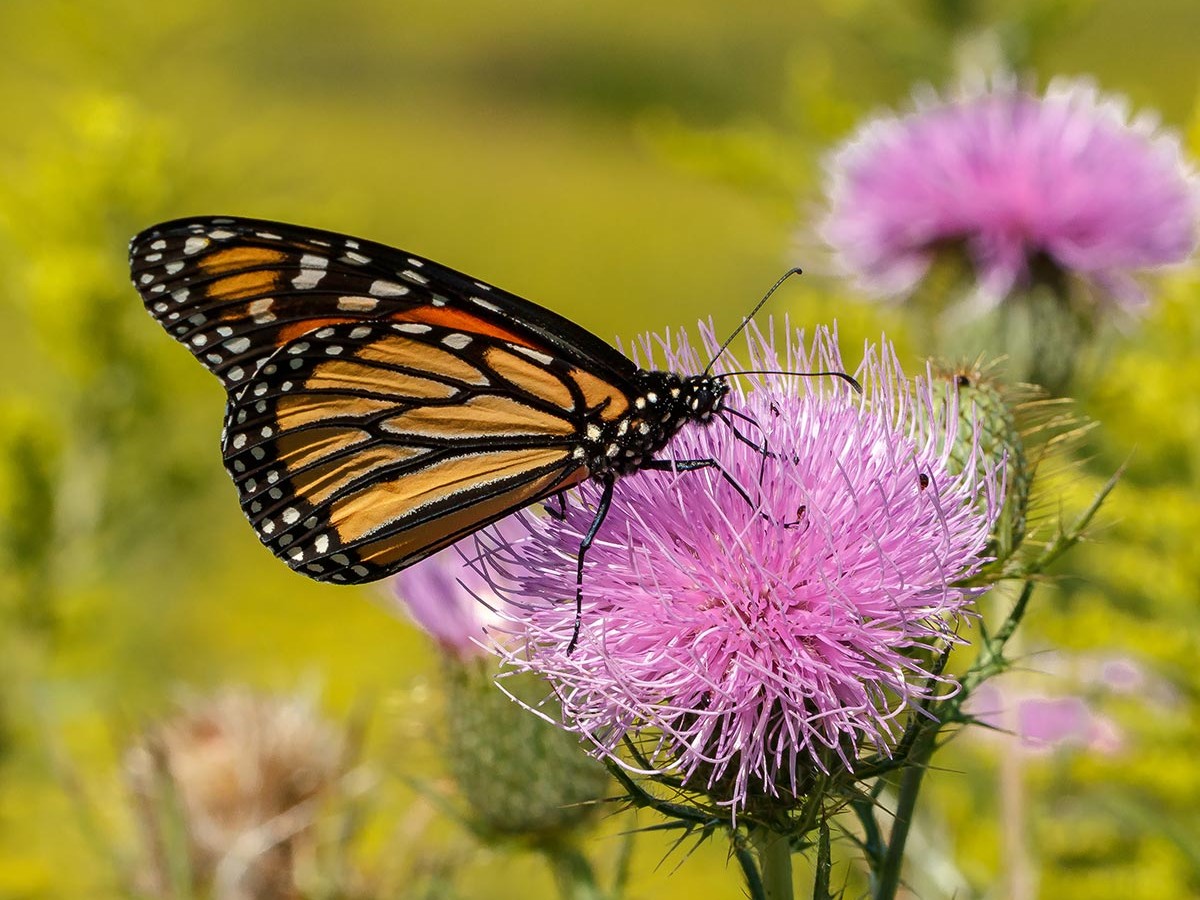
The fall migration of the monarch butterfly (Danaus plexippus) through Delaware is officially in full swing. Shrinking daylight and crisp early-autumn air signal a dramatic shift across our state’s meadows, coastal dunes, and backyards. Peak adult sightings build in late August, and the tagging midpoint hits our latitude by late September.
Most gardeners know that monarch caterpillars require milkweed (Asclepias) to grow and survive. However, larval host plants are only half of the conservation equation. To support monarchs across their extraordinary range, we must examine the distinct fueling requirements of every stage in their lifecycle, especially the critical adult stage.
The Four-Generation Relay
To understand Delaware’s role in the monarch journey, it helps to look at how these butterflies move across North America. An individual monarch does not make the entire round-trip journey on its own. Instead, it takes a multi-generational relay working in sequence to complete the annual cycle.
- Spring Arrivals (May–June): Monarchs waking up in Mexico fly north into the Gulf States to lay eggs and die. Their offspring push northward along the coast, with their leading edge reaching the Delmarva Peninsula in late May, followed by a larger summer wave in June.
- Summer Breeders (June–August): Over the summer, successive short-lived generations breed across Delaware meadows while expanding further north into New England and Canada. These summer adults live for only two to six weeks, devoting their short lives entirely to mating and building up the population across the continent.
- The Fall “Super Generation” (Late August–October): As daylight shortens in late summer, the final generation of the year emerges across Canada, New England, and right here in Delaware with a completely different job. Most delay mating and reproduction. Instead, they save their energy, and begin the long flight south to Mexico.
While summer monarchs rely on milkweed to lay eggs and build the population, this fall super generation relies heavily on late-season nectar to survive their 3,000-mile flight.
The Monarch “Super Generation” Physiology
The migratory generation that emerges in late summer and early fall across Delaware, northern states, and southern Canada faces a completely different environmental reality than its predecessors.
Triggered by decreasing photoperiods, or the shorter day-night cycle, along with other seasonal cues, these late-season butterflies enter reproductive diapause, a physiological state where sexual maturity is suspended to preserve metabolic energy. Instead of mating or laying eggs, this migratory “super generation” undergoes key physical shifts: developing slightly larger, more pointed wings adapted for soaring and gliding, alongside deeper orange wing pigments that absorb thermal morning energy.
Over the next several weeks, these monarchs travel south along the Atlantic Flyway, navigating toward the oyamel fir forests (Abies religiosa) of Angangueo, Mexico. To survive both the 3,000-mile journey and the four-month roosting period in the Mexican mountains, monarchs cannot rely on stored larval energy. They must feed voraciously as adults, converting floral nectar directly into dense abdominal fat reserves.
Host Plants vs. Adult Monarch Fuel Needs
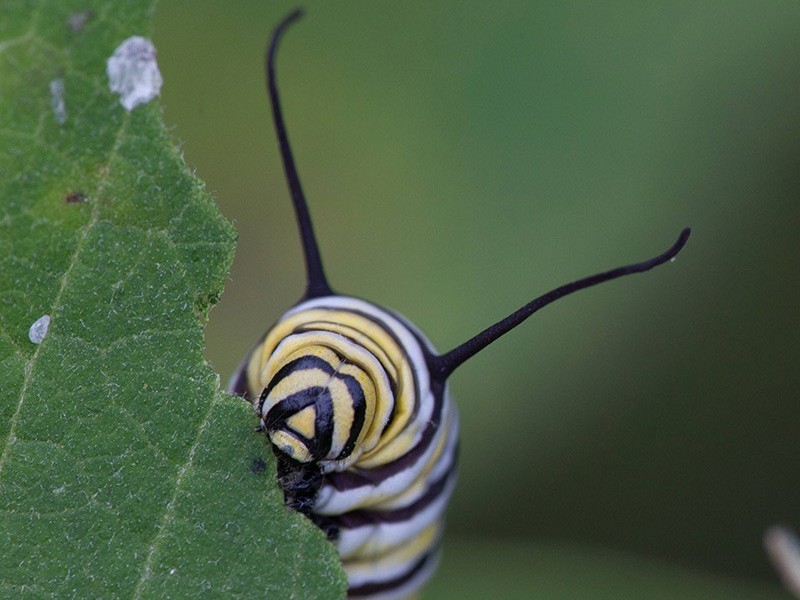
This physiological shift explains a common misconception in habitat gardening: that planting milkweed alone fulfills a monarch’s complete needs. Monarch caterpillars are specialized herbivores that rely exclusively on milkweed foliage, ingesting cardenolides (cardiac glycosides) that help protect them from predators. Adult monarchs can and do nectar on milkweed, but they are surprisingly inefficient milkweed pollinators. Because their bodies are large relative to milkweed’s small, trap-like flower structures, adults frequently sip nectar without successfully extracting or transferring pollen packets (pollinia). Furthermore, individual milkweed flowers yield nectar in limited drops, making them a less efficient source for the substantial caloric intake migrating adults need to build lipid reserves.
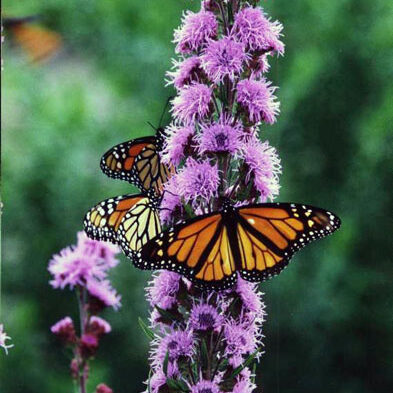
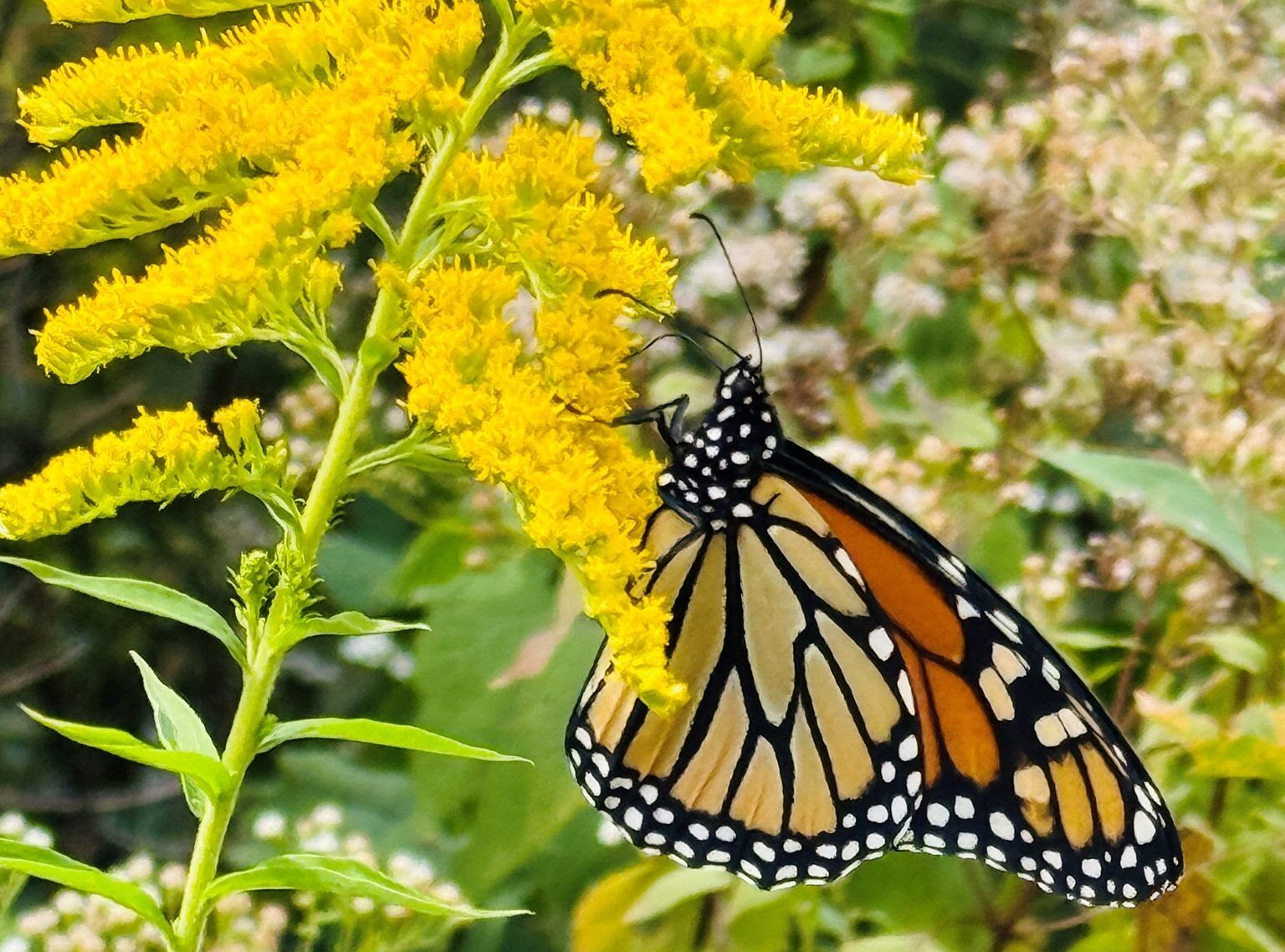
During fall migration, monarchs need abundant nectar sources blooming along their route. A garden designed only around milkweed therefore does not provide everything migrating monarchs need. Late-season flowers like goldenrods, asters, and blazing stars provide dense clusters of accessible flowers where adults can feed efficiently and build the fat reserves needed for long-distance flight.
| Native Plant Name | Lifecycle Role | Ecological Value for Monarchs |
| Common Milkweed (Asclepias syriaca) | Larval Host | Primary foliage for caterpillars; summer nectar. |
| Swamp Milkweed (Asclepias incarnata) | Larval Host | High-value host plant for moist soils and garden beds. |
| Goldenrods (Solidago spp.) | Adult Fuel | Essential late-season nectar source for fall lipid accumulation. |
| Asters (Symphyotrichum spp.) | Adult Fuel | Important late-season nectar source extending into autumn. |
| Blazing Stars (Liatris spp.) | Adult Fuel | Sturdy landing platform delivering a valuable nectar source during peak flight. |
The Ecological Trap of Tropical Milkweed
Well-meaning gardeners often purchase Tropical Milkweed (Asclepias curassavica) because it remains green and continues blooming late into the autumn. In Delaware and the Mid-Atlantic, this non-native plant presents two serious ecological threats:
- Disrupting Migration Triggers: Native milkweeds naturally senesce and die back as autumn progresses. During unusually warm autumns, non-native Tropical Milkweed can remain green and available later than native species, potentially disrupting the seasonal cues associated with migration. Migrating females may break reproductive diapause and begin laying eggs, diverting energy from migration and producing late-season offspring unlikely to complete the journey south.
- Parasite Trapping (Ophryocystis elektroscirrha / OE): OE is a microscopic protozoan parasite. Tropical milkweed that persists late into the season can accumulate OE spores on its leaves. When native milkweed dies back each winter, OE spores are naturally cleared from the environment. Because tropical milkweed survives later into the season, spores accumulate on its leaves. Caterpillars ingest these spores, resulting in adult emergence with crippled wings, low flight stamina, or death.
To safeguard the migratory corridor, regional gardens should rely exclusively on species locally native to Delaware, such as Common Milkweed (Asclepias syriaca), Swamp Milkweed (A. incarnata), or Butterfly Weed (A. tuberosa).
Refueling Along the Mid-Atlantic Corridor
Delaware forms a key stopover along the Eastern Seaboard migration route. Local monitoring data from counting stations, including the hawk watch at Ashland Nature Center and coastal monitoring stations along Delaware Bay, indicate that monarch migration increases through September, with stragglers moving through into November.
Property owners can transform gardens and fields into refueling waystations by planting late-blooming native perennials:
- Goldenrods (Solidago nemoralis, S. speciosa, S. rugosa)
- Asters (Symphyotrichum novae-angliae, S. laeve, S. oblongifolium)
- Joe-Pye Weed (Eutrochium fistulosum, E. maculatum)
- Ironweed (Vernonia noveboracensis)
Avoiding aggressive fall garden cleanup is equally critical. Cutting down late-season composites in September or October removes vital nectar resources right as migrating adults arrive.
Take Action
You can help strengthen Delaware’s migratory corridor today:
- Plant Late-Season Nectar Native Species: Add Goldenrods (Solidago), Asters (Symphyotrichum), and Joe-Pye Weed (Eutrochium) to supply high-calorie adult fuel.
- Remove Tropical Milkweed: Replace exotic Asclepias curassavica with native Common, Swamp, or Butterfly Milkweed to reduce the risk of parasite buildup and avoid disrupting normal migration behavior.
- Delay Autumn Garden Cleanup: Leave late-blooming flowers standing through November so late-migrating monarchs can refuel.
Milkweed gives monarchs a place to begin. Late-blooming native flowers help give the migratory generation the fuel to continue. By planting for both caterpillars and adults, Delaware landscapes can support monarchs through more of their remarkable annual journey.
Learn More & Monarch Research Resources
Explore the scientific research, local tracking databases, and plant guides used to compile this post:
- Local Delaware Migration Timing & Native Seed Planting: MyWild Report – Delaware Monarch Timing & Milkweed
- Delaware Environmental Education & Hawk Watch Counts: Delaware Nature Society – Monarchs, Migration and Motus
- Spring Migration Mechanics & Multi-Generational Tracking: MonarchNet – Spring Migration Ecology
- Physiology of Diapause & Lipid Accumulation: PubMed Central – Monarch Genetics & Flight Physiology (PMC6834359)
- Wing Pigmentation & Flight Performance: The Redder the Better: Wing Color Predicts Flight Performance in Monarch Butterflies (PMC3405115)
- Tropical Milkweed Risks & OE Disease Dynamics: Monarch Joint Venture – Tropical Milkweed Factsheet & Project Monarch Health
- Regional Nectar Selection Guides: Pollinator Partnership – Monarch Nectar Guides & Xerces Society for Invertebrate Conservation


0 Comments